
Climbing grades conversion table: sport routes and bouldering
Understand climbing grades, compare sport and bouldering systems separately, and choose destinations with your experience and climbing style in mind.

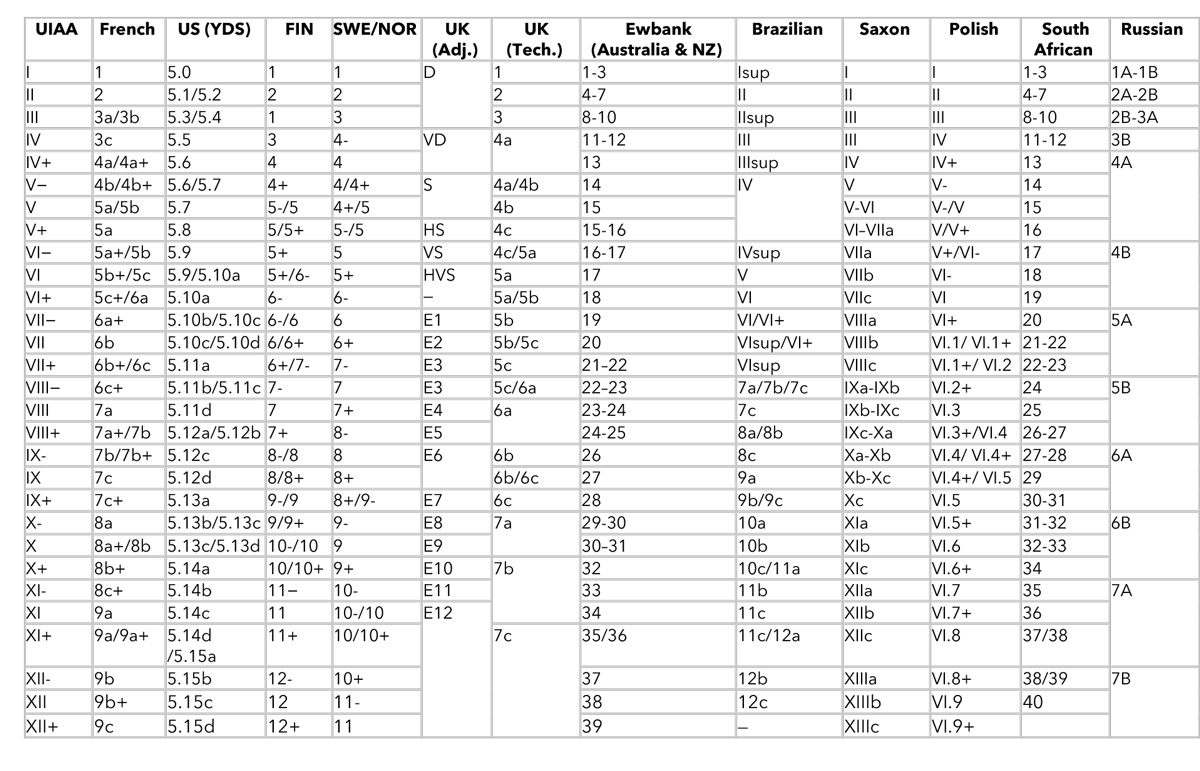
New guidebook, unfamiliar grades? Start here. These tables help you compare the numbers on roped routes and boulder problems, then choose what to look at more closely. A conversion gives you a starting point; the route, climbing style and skills you bring decide whether it is a good choice for you.
Jump to: sport route table · bouldering table · destinations and courses
Climbing grades explained from zero
A route is a line on rock or an indoor wall, often climbed with a rope. A boulder problem is a short sequence usually climbed without one, with mats and a planned landing. Both have grades to describe their difficulty. Neither number tells you everything about the climb.
Within the same system, higher grades mean harder climbing. French sport grades go 6a, 6a+, 6b. In the Yosemite Decimal System (YDS), 5.10a comes before 5.10b. Read 5.10 as a climbing grade, not the decimal number 5.1.
Keep the system next to the number. French sport 6a and Fontainebleau bouldering 6A are different grades, even though they look almost identical. British technical 6a means something else again. Roman numerals might be UIAA or a local sandstone scale, so check the guidebook before comparing them.
You will often meet French grades on European sport routes, YDS in North America, UIAA in parts of Europe, and Ewbank in Australia and New Zealand. For bouldering, look for Font or Hueco/V. These are useful clues, but the guidebook's grading notes have the final say.
Sport and roped route comparison
Find your French grade in the first column and read across for an approximate comparison. This table follows Mountain Project from 4a to 9c, including the + steps from 6a+ onward. Some French grades have more than one comparison in its chart; we use one complete source row for each grade. Grades below 4a exist too, and 9c is the highest grade in this source, not a fixed limit of the scale.
French sport route | YDS roped route | UIAA roped route | Ewbank roped route (AU/NZ) |
|---|---|---|---|
4a | 5.4 | IV | 12 |
4b | 5.5 | IV+ | 13 |
4c | 5.6 | V | 14 |
5a | 5.7 | V+ | 15 |
5b | 5.8 | VI- | 16 |
5c | 5.9 | VI | 17 |
6a | 5.10a | VI+ | 18 |
6a+ | 5.10b | VII- | 19 |
6b | 5.10c | VII | 20 |
6b+ | 5.10d | VII+ | 21 |
6c | 5.11a | VII+ | 22 |
6c+ | 5.11c | VIII- | 24 |
7a | 5.11d | VIII | 24 |
7a+ | 5.12a | VIII+ | 25 |
7b | 5.12b | VIII+ | 26 |
7b+ | 5.12c | IX- | 27 |
7c | 5.12d | IX | 28 |
7c+ | 5.13a | IX+ | 29 |
8a | 5.13b | IX+ | 29 |
8a+ | 5.13c | X- | 30 |
8b | 5.13d | X | 31 |
8b+ | 5.14a | X+ | 32 |
8c | 5.14b | X+ | 33 |
8c+ | 5.14c | XI- | 34 |
9a | 5.14d | XI | 35 |
9a+ | 5.15a | XI+ | 36 |
9b | 5.15b | XII- | 37 |
9b+ | 5.15c | XII | 38 |
9c | 5.15d | XIII- | 39 |
Source: Mountain Project's International Climbing Grade Comparison Chart, checked 10 October 2026. Use it to get your bearings, then read the route description: these numbers do not compare protection, exposure or the whole undertaking. UIAA, YDS and Ewbank also appear on trad routes, where protection and seriousness notes matter.
An Ewbank number does not tell you that a route has sport-style protection. Local practice can take more than the moves into account. Read the Australian or New Zealand guidebook's grading notes and route description; Rockfax's Ewbank explanation covers this wider context.
Why might your guidebook show something different? Charts disagree. Mountain Project puts French 7a beside YDS 5.11d; the German Alpine Club (DAV) chart, printed page 13, uses 5.11c. DAV gives 6c as UIAA VII+/VIII-, while our Mountain Project row gives VII+. Keep the original grade in mind and use the conversion to narrow your search, rather than predict a send.
The differences continue at the top end. UIAA's worldwide comparison pairs French 9c with YDS 5.15d and Ewbank 39, but uses UIAA XII+ instead of Mountain Project's XIII-. UIAA also puts 8c+ beside 5.14b and 9a beside 5.14c; our Mountain Project rows use 5.14c and 5.14d. These are each chart's comparisons, not a single internationally agreed standard.
Bouldering comparison: Font and Hueco/V
For bouldering, use this separate V/Font table. It covers V0 to V17. Where one V grade spans two Font grades, both are shown, for example V3 = 6A/6A+. Keep the capital letters: Font 6A is not French sport 6a.
Hueco / V boulder | Fontainebleau / Font boulder |
|---|---|
V0 | 4 |
V1 | 5 |
V2 | 5+ |
V3 | 6A/6A+ |
V4 | 6B/6B+ |
V5 | 6C/6C+ |
V6 | 7A |
V7 | 7A+ |
V8 | 7B/7B+ |
V9 | 7B+/7C |
V10 | 7C+ |
V11 | 8A |
V12 | 8A+ |
V13 | 8B |
V14 | 8B+ |
V15 | 8C |
V16 | 8C+ |
V17 | 9A |
Source: Rockbusters bouldering conversion, updated 9 November 2026. V0 can still feel tough on unfamiliar rock. Look at the moves, height, landing and conditions before getting on.
Worked examples and honest trip selection
Say you regularly climb French sport 6a. The route table points you towards YDS 5.10a. If you boulder Font 6A, the separate boulder table points towards V3. Those comparisons stay within their discipline: a 6a route and a 6A problem do not ask for the same moves, endurance or fall management.
For roped routes, an onsight is a clean lead ascent on the first attempt without prior route-specific information. A flash is a clean lead ascent on the first attempt with prior information, such as watching someone climb or receiving beta. A redpoint is a clean lead ascent after prior attempts or practice. Here, clean means without falling, resting on the rope or pulling on protection. Bouldering also uses onsight and flash for first-attempt ascents without falling or artificial assistance, with or without prior information respectively. These terms describe ascent style, rather than changing the climb's printed grade.
On top-rope, the rope passes through an anchor above the climber. When leading a sport route, the climber clips protection as they go. Similar movement grades do not make these the same task: leading adds clipping, route management and different falls. Learning to belay or lead requires instruction and practice, not a conversion table.
Your gym grade is useful background, but walls and setters vary. Outdoors, a slab, a steep tufa and a long sustained pitch can feel very different at the same grade. When planning a trip with us, tell us what you climb comfortably and regularly, indoors or outdoors, on lead or top-rope, and which styles are new to you.
Try this: "I regularly lead French 5c outdoors on slabs, and have redpointed one familiar 6a; steep routes are new to me." That gives us much more to work with than "I climb 6a" and helps us discuss the right course or sectors with you.
Trad, sandstone and alpine grades need their own context
British trad grades have two parts, such as VS 4c or E1 5a. The adjectival part summarises the whole climb, including sustained difficulty and seriousness; the technical part describes the hardest move or short section. Read both with the route description. Neither belongs in a simple one-to-one sport table. See the BMC's introduction to trad climbing and Rockfax's explanation.
Saxon sandstone grades use Roman numerals and add a/b/c subdivisions from VII. They are not automatically UIAA. Czech sandstone areas have regional grading and protection traditions too. Read the local rules and guidebook; do not transfer Saxon rules wholesale to a Czech area. The Saxon climbing rules are a regional reference, not a universal sandstone rulebook.
Alpine grades, approach, retreat, weather and multi-pitch logistics describe commitments that a technical sport number cannot replace. Even a technically modest route can be a serious undertaking. The UIAA's grading overview explains why the systems need context.
Where can I climb at my level?
Start with the climbing you want to do every day. Look for a sector with enough routes or problems at a comfortable grade, then check the style, season, approach and protection or landings. Here are a few places to explore, with the details that matter more than an area's hardest route. Check current guidebooks, access and conditions as you plan.
Looking for easier sport routes around Arco? Start by reading about individual sectors. The local Belvedere description separates a lower wall for less experienced climbers from a harder upper section. That is a useful lead for Belvedere, rather than a description of every Arco crag.
Looking for a winter sport climbing base? The Costa Blanca region around Alicante has many crags within a short drive of each other, so you can pick sectors to suit your grade, the style you want and the day's weather.
One of its best-known crags is Sella. There, the style can change your day as much as the grade. Rockfax's crag description contrasts technical slabs and low-angle walls in the main valley with steep tufas and pockets in Hidden Valley. Pick the sector for the climbing you enjoy or want to learn.
Exploring mid-grade options on Kalymnos? Arginonta Valley and Black Buddha are worth looking up in a current guidebook. The local guidebook team's 2016 account describes adding mid-grade routes there, initially with provisional grades. Use that as background, then check today's grades, access and conditions.
Margalef is famous for its pocketed conglomerate and some very hard sport routes, but its hardest projects do not tell the whole story. Many sectors offer moderate grades too. Pocket pulling can be sharp and hard on the fingers, so look at each sector's style and steepness as well as its grades, especially if you are choosing your first outdoor leads.
Heading to Fontainebleau? Use the Font/V table and explore the local circuits. They can help you plan a session, while you assess each problem's moves, landing and top-out. Read the local circuit descriptions: the colours do not translate directly to your gym's colours or sport grades.
The towers of Adršpach–Teplice call for sandstone skills, not just a converted sport grade. The Czech Mountaineering Federation's 2025 reminder requires dry rock, prohibits chalk and rock-damaging protection such as nuts and cams, and allows textile protection. Get instruction in local methods and check current permissions for Adršpašské skály and Teplické skály before you go.
Ready to take it onto real rock? Explore our Novice course or Sport Climbing Basics for your first outdoor routes, Introduction to bouldering for boulder problems, or Czech Sandstone for local sandstone skills. Tell us about your experience and goals, and ask about prerequisites, dates and available places before booking.
Questions beginners ask
Is French 6a the same as Font 6A?
No. Lowercase 6a here is a sport route grade; uppercase 6A here is a Font boulder grade. Always write the discipline and system next to the number.
Can I use my gym grade to choose an outdoor trip?
Use it as background information alongside your outdoor experience, comfortable grade, ascent style and skills. Ask the organiser about the actual sectors and course prerequisites rather than assuming a direct transfer.
Does a low grade mean a safe climb?
No. A grade does not replace the route description, protection or landing assessment, weather and access information, or the skills required to climb it.
Why does another chart give a different conversion?
Systems developed in different climbing communities and describe difficulty differently. Charts are approximate conventions. Compare the original grade, route description and relevant guidebook instead of treating a conversion as an exact measurement.
Sources and conversion methodology
Sport conversions checked on 10 October 2026. The sport table uses Mountain Project: 29 rows from 4a to 9c, including its + steps from 6a+ onward. Each row follows the source as written; we have not filled gaps with estimated grades. The bouldering table is the Rockbusters V/Font conversion from V0 to V17, updated 9 November 2026. The DAV chart, UIAA historical grading material and UIAA worldwide comparison provide useful context for the differences discussed above.
For more on sport, trad and overall commitment, read Rockfax's grading explanation. theCrag's Grades and Grade Conversions is further reading. Neither is the numerical source for the rows in our tables.